

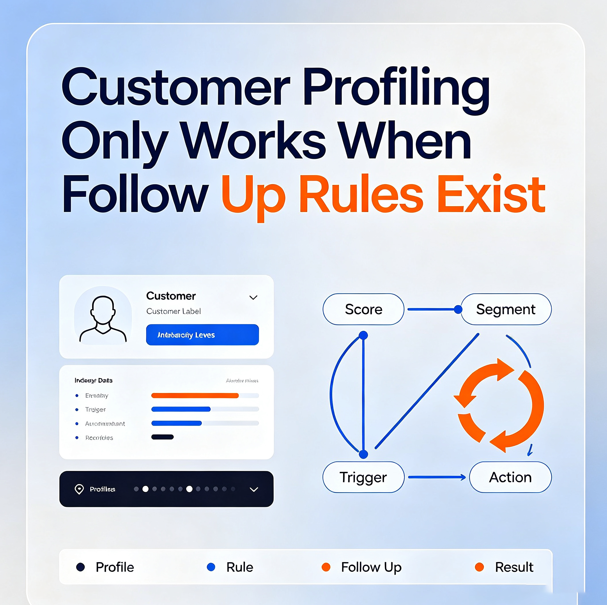
Customer profiling offers valuable insights into a visitor's interests during their website session, but it rarely dictates the next steps for your team. In the B2B landscape, the emergence of an auto-generated client profile marks a crucial transition point where process must take command. Clear definitions for ownership, qualification criteria, and subsequent sales follow-up actions are essential to prevent leads from stagnating.
Why an Auto-Generated Client Profile Isn't a Next Step on Its Own
An auto-generated client profile is best viewed as structured context. While it can make follow-up significantly more relevant, it cannot replace human decision-making. Teams still need to explicitly define which specific behaviors trigger qualification, what constitutes a meaningful opportunity, and who takes responsibility once a lead moves from anonymous visitor activity into a named contact or account record.
In practice, the profile becomes useful only when it is attached to a workflow. Without that layer, information remains descriptive rather than operational. A system may detect pages visited, time spent, referral source, company attributes, or repeat visit patterns, but none of those signals create business value until someone translates them into an action such as outreach, nurture, escalation, routing, or disqualification.
This distinction matters in B2B because purchase cycles are usually longer, involve multiple stakeholders, and require stronger internal coordination. Marketing may identify intent signals, but sales needs a reliable way to interpret those signals consistently. That is why mature teams define thresholds, service expectations, and visible ownership rules instead of assuming that profile quality alone will drive conversion.
Define Qualification Before You Automate Follow-Up
Before building automations, teams should agree on what “qualified” actually means. Qualification can include fit-based indicators such as company size, industry, region, product relevance, or strategic account status. It can also include behavior-based indicators such as pricing-page visits, return sessions, demo requests, form completions, or repeated engagement with technical content.
Research on B2B lead handling consistently shows that fit and expressed interest should both influence prioritization. The closer a prospect matches an ideal customer profile and the stronger the interest signal, the more likely the lead deserves rapid attention. This also helps reduce the common problem of leads entering a system but receiving uneven or delayed response.
A simple internal qualification model often works better than an overly complex one. For example, teams can label leads across three practical states:
- High priority: strong ICP match and strong intent signals.
- Review needed: partial fit or unclear intent, requiring quick human screening.
- Nurture: early-stage interest, low urgency, or incomplete qualification data.
Once these categories exist, an auto-generated client profile can feed them automatically. That is the point where profiling begins to support measurable sales follow-up actions instead of acting as a passive data snapshot.
Build a Repeatable Workflow Across Teams and Channels
The most effective setup is not a single tool feature but a repeatable sequence. A practical B2B workflow often looks like this: First visit → customer profiling → lead capture → qualification check → assignment → follow-up → review. This structure gives every stage a clear purpose and makes it easier to track where conversion slows down.
Routing rules are especially important. If a lead is qualified, the system should assign it based on the logic your team already uses, such as geography, account ownership, product line, language, or segment. If a lead is not yet ready for sales, it should move into a nurture track instead of sitting untouched in a queue. That protects sales time while still preserving future demand.
Strong workflows also depend on alignment between marketing and sales. Teams should use shared definitions, shared dashboards, and a shared understanding of timing. If marketing marks too many leads as ready, sales confidence drops. If sales ignores intent-rich leads, the funnel loses efficiency. The workflow must therefore support both accountability and feedback.
A repeatable B2B workflow makes lead handling visible and manageable.
When this sequence is embedded in a platform such as Italkin, teams can move from fragmented observations to coordinated execution. Instead of relying on memory or ad hoc exports, they can see which visitor actions created a profile, which rule triggered routing, and which follow-up steps are still pending. That visibility is what turns operational discipline into a conversion advantage.
Turn Profiles Into Measurable Sales Follow-Up Actions
To make customer profiling operational, every qualified event should map to a next action with a measurable outcome. Examples include assigning a rep, creating a callback task, triggering an email sequence, opening a CRM record, or flagging an account for manager review. The goal is not merely activity generation but action traceability.
Useful measurements usually include response time, follow-up completion rate, meeting conversion rate, sales acceptance rate, and progression by segment. These indicators help teams answer important questions: Are qualified leads actually being contacted? Are the right reps receiving the right leads? Are some signals overrated while others predict pipeline movement more effectively?
Behavioral data can be especially powerful when it is interpreted in context. A single content visit may mean little, while a sequence of visits across product, pricing, and case-study pages may suggest evaluation intent. Likewise, repeated engagement from the same company across multiple sessions may indicate buying committee activity. The profile becomes more actionable when it summarizes not just who the visitor appears to be, but how their behavior relates to urgency and fit.
A compact action matrix can keep execution consistent:
| Profile signal | Likely meaning | Suggested next action |
|---|---|---|
| Strong ICP match and demo request | High intent | Immediate assignment and personal outreach |
| Repeat visits to product and pricing pages | Evaluation stage interest | Prompt qualification review and tailored follow-up |
| Content engagement with limited firmographic fit | Early-stage or low-fit interest | Nurture sequence and monitoring |
| Single short visit with no capture event | Weak signal | No sales action, keep anonymous analytics only |
Use Dashboards to Prevent Lead Stagnation
Dashboards are not just reporting surfaces; they are control systems for execution. Once an auto-generated client profile feeds lead capture and routing logic, dashboards should show where leads are accumulating, how quickly they are moving, and whether follow-up standards are being met. Without that visibility, even a well-designed workflow can quietly fail.
At minimum, teams should track:
- new profiles created from website activity,
- lead capture rate from profiled visitors,
- qualified leads by source and segment,
- time to first sales action,
- unworked or aging leads,
- handoff outcomes between marketing and sales.
These metrics help expose bottlenecks quickly. If lead volume is healthy but follow-up is slow, the issue may be assignment capacity or unclear ownership. If follow-up is fast but conversion is weak, the qualification threshold may be too loose. If certain segments outperform others, the scoring model may need reweighting. Dashboards make those patterns visible early enough to correct them.
A Simple Operating Model for B2B Teams
A practical operating model combines three layers: profile generation, decision rules, and execution tracking. The first layer captures visitor and company signals. The second translates those signals into qualification and routing. The third confirms whether follow-up actually happened and whether it created pipeline value.
Teams do not need to launch with a perfect scoring system. They need a reliable loop that can improve over time. Start with a few high-confidence signals, connect them to explicit actions, review results weekly, and refine the rules using actual conversion outcomes. This approach is often more effective than trying to predict everything at once.
That loop is where customer profiling becomes commercially meaningful. It shifts the conversation away from abstract audience understanding and toward repeatable, accountable sales execution.