

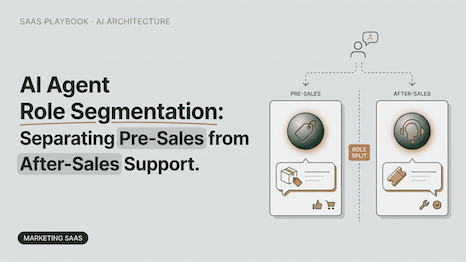
Why AI Agent Roles Need Segmentation: Separating Pre-Sales Recommendations from After-Sales Support
As more B2B companies integrate AI Agents into their customer engagement workflows, a key challenge becomes increasingly clear: pre-sales inquiries and after-sales support require fundamentally different conversational approaches.
A potential buyer looking for the right product solution has a completely different intent from an existing customer seeking technical assistance or service support. When a single AI Agent handles both scenarios without clear role differentiation, responses can become less relevant, conversations may lose context, and the overall customer experience becomes harder to optimize.
Why Mixed AI Agent Roles Create Customer Experience Challenges
Pre-sales support focuses on discovery, qualification, and conversion. Visitors may need product information, solution recommendations, pricing guidance, quotation requests, meeting scheduling, or assistance before they are ready to connect with a sales representative.
After-sales support serves a different purpose. It focuses on resolving customer issues, answering service-related questions, troubleshooting problems, and maintaining long-term customer relationships.
When the same AI Agent handles both roles without proper segmentation, problems can occur.
For example, if an existing customer contacts support about a product issue and receives sales recommendations instead of a solution, they may feel misunderstood. On the other hand, if a high-intent buyer is treated like a routine support case, a valuable sales opportunity may be missed.
This is why AI Agent Role Segmentation is becoming an essential design principle for conversational AI, especially for global B2B companies managing customer interactions across websites, messaging platforms, email, and social channels.
What Effective AI Agent Role Segmentation Should Include
Effective role segmentation does not mean creating unnecessary complexity. Instead, it means giving each AI Agent a clear purpose, conversation style, and workflow responsibility.
A well-structured AI Agent system ensures that every customer receives the right support at the right stage of their journey.
| Customer Stage | AI Agent Role | Main Responsibility | Typical Outcome |
|---|---|---|---|
| Early Inquiry | Pre-Sales Guide | Identify needs and answer product questions | Better-qualified inquiry |
| Product Evaluation | Recommendation Assistant | Suggest relevant products based on buyer needs | Clearer buying direction |
| Conversion Stage | Lead Capture Assistant | Collect contact details and support meeting booking | Sales-ready lead |
| Post-Purchase Stage | Support Assistant | Answer after-sales questions and service requests | Faster support response |
| Ongoing Relationship | Customer Management Assistant | Support tagging, segmentation, and follow-up continuity | More organized customer lifecycle |
This structured approach helps companies preempt role confusion while maintaining a seamless and logical customer journey. It also facilitates cleaner team operations, as each conversation can be routed, reviewed, and continuously improved according to its specific purpose and stage.
How Italkin Supports a Layered Customer Journey
For companies looking to implement an AI chatbot or AI Agent solution, Italkin demonstrates how customer conversations can be organized throughout the B2B lifecycle.
The platform supports multiple customer engagement scenarios, including product recommendations, lead qualification, meeting scheduling, and customer support. With 112-language auto-detection and response capabilities, it enables global customers to communicate in their preferred languages.
Its OmniChat feature connects multiple communication channels, including WhatsApp, Facebook Messenger, TikTok, Instagram, LINE, Email, VKontakte, and more, into one unified inbox.
This is especially important for role segmentation. A customer may start with a product inquiry through a website chatbot, continue the conversation through social messaging, and later return with a support request. By centralizing customer conversations, businesses can preserve context and ensure consistent communication throughout the customer lifecycle.
Italkin also provides customizable AI Agent personas, intelligent lead routing rules, customer data management, visitor behavior analytics, operational dashboards, and service performance insights. These capabilities help teams define clearer responsibilities, identify missed conversations, improve response efficiency, and manage customer handoffs more effectively.
Practical Steps to Build Better AI Agent Workflows
Companies can improve AI Agent workflows through five key steps:
1. Categorize customer conversations
Identify common interaction types, including product inquiries, quotation requests, meeting scheduling, support questions, and follow-up conversations.
2. Define each AI Agent’s responsibility
Each AI Agent should have a clear purpose. A pre-sales assistant should focus on discovery and conversion, while a support assistant should focus on issue resolution.
3. Establish clear handoff rules
When a conversation becomes sales-ready, it should move into the sales workflow. When it becomes a service request, it should be routed to the appropriate support process.
4. Maintain structured customer data
Use customer tags, priority levels, segmentation, and conversation history to preserve context across different touchpoints.
5. Monitor and optimize performance
Track response time, missed conversations, lead quality, customer satisfaction, and workflow efficiency through analytics dashboards.
By applying these practices, companies can transform AI Agents from disconnected chat tools into coordinated digital assistants that support both business growth and customer retention.
The Customer Experience Impact
AI Agent Role Segmentation is not simply a technical configuration; it is a strategic approach to improving customer engagement.
Buyers expect relevant recommendations, fast responses, and smooth transitions throughout the purchasing journey. Existing customers expect support that understands their needs without unnecessary sales interruptions.
By creating clearly defined AI Agent roles, businesses can achieve both goals: higher pre-sales conversion and more reliable after-sales support.
For global B2B teams, the strongest results come from combining role-based AI workflows with unified customer data, multilingual communication, omnichannel engagement, and measurable performance management.
This is where AI-powered chatbot platforms move beyond basic chat widgets and become part of a structured customer engagement system.
FAQs
What is AI Agent Role Segmentation?
AI Agent Role Segmentation refers to assigning different responsibilities to AI roles, such as product recommendations, lead qualification, customer support, and relationship management. This ensures each customer interaction is handled according to its purpose.
Why should pre-sales and after-sales support be separated?
Pre-sales focuses on understanding customer needs and driving conversion, while after-sales focuses on solving problems and maintaining customer relationships. Separating these roles creates more relevant and efficient conversations.
Can one AI Agent support the entire customer journey?
Yes. A single AI Agent can support the full customer journey when supported by clear workflows, routing rules, and role-based instructions.
How does omnichannel messaging improve role segmentation?
Omnichannel messaging brings conversations from websites, social media, email, and messaging platforms into one workspace, making it easier to maintain context and route conversations correctly.
What should companies monitor after deploying segmented AI Agent roles?
Companies should monitor response time, missed conversations, lead quality, customer behavior patterns, conversion data, and customer service performance metrics.