

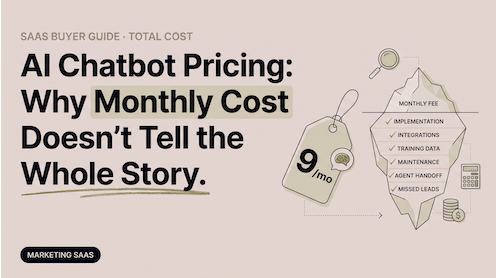
AI chatbot pricing often looks simple when buyers compare monthly plans side by side. Yet, the real AI chatbot cost depends on much more than the subscription line: usage rules, operator seats, language needs, channel coverage, content limits, setup work, and the manual effort that remains after deployment. For global B2B teams using conversational AI for customer service or lead generation, the smarter question isn't "Which plan is cheapest?" but "Which option delivers the required function value at the lowest combined cost?"
Low Monthly Fees Can Create Expensive Surprises
A low monthly fee isn't automatically a low operating cost. Across the chatbot market, vendors may price by subscription, conversation, message, resolution, seat, workspace, channel, or a mix of several models. That means two tools with similar advertised prices can produce very different invoices once website traffic grows or more teams begin using the system.
Before any AI chatbot comparison, procurement teams should map the expected workload. Important checkpoints include:
- Monthly conversation or message volume
- Overage rules when usage exceeds the plan
- Number of human operators or seats included
- Website, live chat, social, and other supported channels
- Language requirements for target markets
- Content capacity and update requirements
- Setup, integration, and ongoing management effort
For an AI Chatbot website serving international buyers, a small restriction during a pilot can become a meaningful cost after traffic scales. The cheapest entry plan may still require extra tools, manual routing, or a higher tier sooner than expected.
Compare Chatbot Features Before Comparing Price
AI chatbot pricing should be evaluated against the customer journey the system needs to support. For B2B sales and service teams, the most important chatbot features usually sit around six practical areas.
| Evaluation area | What buyers should confirm | Possible cost impact |
|---|---|---|
| Language needs | Whether target-market languages are supported | Extra translation tools or human handling |
| Conversation volume | Included usage and scaling rules | Overage fees or plan upgrades |
| Content use | Capacity, update process, and response boundaries | More content operations work |
| Lead identification | How chats become actionable sales inquiries | Manual qualification workload |
| Proactive marketing | Whether engagement can start before visitors leave | Separate marketing tools |
| CRM/API needs | How data moves into sales or service systems | Integration work or middleware |
Italkin's official product structure presents Italkin AI Chatbot, Multilingual Live Chat, AI Agent, and Proactive Marketing as product categories. Our portfolio also includes OmniChat. For buyers evaluating AI-driven chatbots, these categories make it natural to compare more than basic question answering; engagement, lead handling, and communication channels should also be part of the assessment.
Real AI Chatbot Cost Includes Hidden Workload
When companies compare chatbot plans, the most visible charge is often the monthly subscription, but that number rarely reflects the full operating picture. Hidden workload appears when automation stops short of the actual business process. If multilingual coverage is incomplete, staff may need to intervene. If lead capture lacks structure, sales teams spend more time qualifying conversations manually. If integrations are limited, teams may export, copy, route, or reconcile data by hand across multiple systems. These operational gaps create recurring cost, even when the software plan itself looks affordable.

A practical cost model is simple:
Real AI chatbot cost = subscription + usage charges + extra tools + setup or integration work + remaining manual workloadThis formula prevents a low monthly plan from looking better than it really is. If an AI sales chatbot cannot support required markets, capture usable lead context, or connect smoothly with follow-up workflows, the missing work doesn't disappear. Instead, it shifts to sales, support, marketing, or IT teams. This might mean sales teams spend more time manually qualifying leads that the chatbot couldn't fully vet, support agents needing to switch contexts constantly due to fragmented conversations, or marketing teams struggling to personalize outreach without integrated customer data. IT departments, too, face increased burdens from complex, piecemeal integrations or the need to build custom connectors, all adding to the overall cost.
The Italkin Platform presents AI Chatbot alongside Marketing Automation Workflows, Customer Profiling, Analytics & Reporting, and Personality Customization. For B2B companies comparing conversational AI options, this broader platform view supports a more useful question: how well does the tool fit the complete customer engagement process?
Chatbot ROI Comes From Function Value
Chatbot ROI should be measured by the business process improved, not solely by the monthly software bill. In AI customer service, value may come from faster inquiry handling and more consistent responses. For instance, a well-implemented AI chatbot can significantly reduce response times from hours to seconds, ensuring customers receive immediate, accurate information around the clock. This consistency not only improves satisfaction but also frees human agents to focus on more complex issues.
In AI lead generation, value depends on whether conversations can become structured opportunities for follow-up. The value isn't just about initiating conversations; it's about the chatbot's ability to ask qualifying questions, gather critical data points, and seamlessly hand off warm leads with rich context directly to sales. This structured approach ensures sales teams receive higher-quality opportunities, drastically improving conversion rates and reducing time spent on unqualified prospects.
The decision rule is straightforward: compare function value against total combined cost, not subscription price against subscription price.
For global B2B companies, this means documenting required chatbot features first, testing the workflow against real visitor scenarios, and confirming pricing terms before signing. Buyers evaluating the best AI chatbot platforms for global businesses should pay particular attention to usage boundaries, language coverage, channel fit, and the amount of human work still required after launch.
Practical Checklist for B2B Buyers
Before choosing an AI-powered chatbot, ask these questions:
- Which markets, languages, and channels must be covered from day one?
- What happens when conversation volume increases?
- Are AI usage, seats, and support included or billed separately?
- Can the system help turn website chats into actionable leads?
- Does the workflow support sales follow-up, reporting, and customer profiling needs?
- What setup, integration, and content maintenance work will internal teams handle?
- Does the expected chatbot ROI justify the combined cost over time?
A plan that answers these questions clearly is often more valuable than a plan that simply looks cheaper.
From Monthly Price to Business Value
AI chatbot pricing only tells part of the story. For B2B teams expanding into overseas markets, the better purchasing lens is total cost of ownership: what the business pays to obtain, operate, and complete the customer communication workflow. Huazhi Big Data and Shandong Huazhi Big Data Co., Ltd. present Italkin through www.italkin.chat, with product categories related to AI-powered communication, live chat, platform workflows, and global customer engagement.
FAQs
Is the cheapest AI chatbot plan always the lowest-cost option?
No. A low subscription can become expensive if usage charges, extra seats, additional tools, setup work, or manual handling are required.
What should B2B buyers compare first?
Start with required functions: languages, conversation volume, channels, content use, lead identification, proactive engagement, CRM/API needs, analytics, and follow-up workflow.
How should chatbot ROI be measured?
Measure chatbot ROI by function value over combined cost. The key question is whether the tool improves customer service, lead capture, and sales follow-up enough to justify the full operating cost.
Which Italkin product categories are relevant to this comparison?
Italkin presents AI Chatbot, Multilingual Live Chat, AI Agent, Proactive Marketing, OmniChat, Marketing Automation Workflows, Customer Profiling, Analytics & Reporting, and Personality Customization.